Two towers, same age, same view, nearly the same monthly assessment. In one, the owners are about to get a letter about a five-figure special assessment. In the other, they're not. The difference is visible before you ever make an offer — if you know where to look.
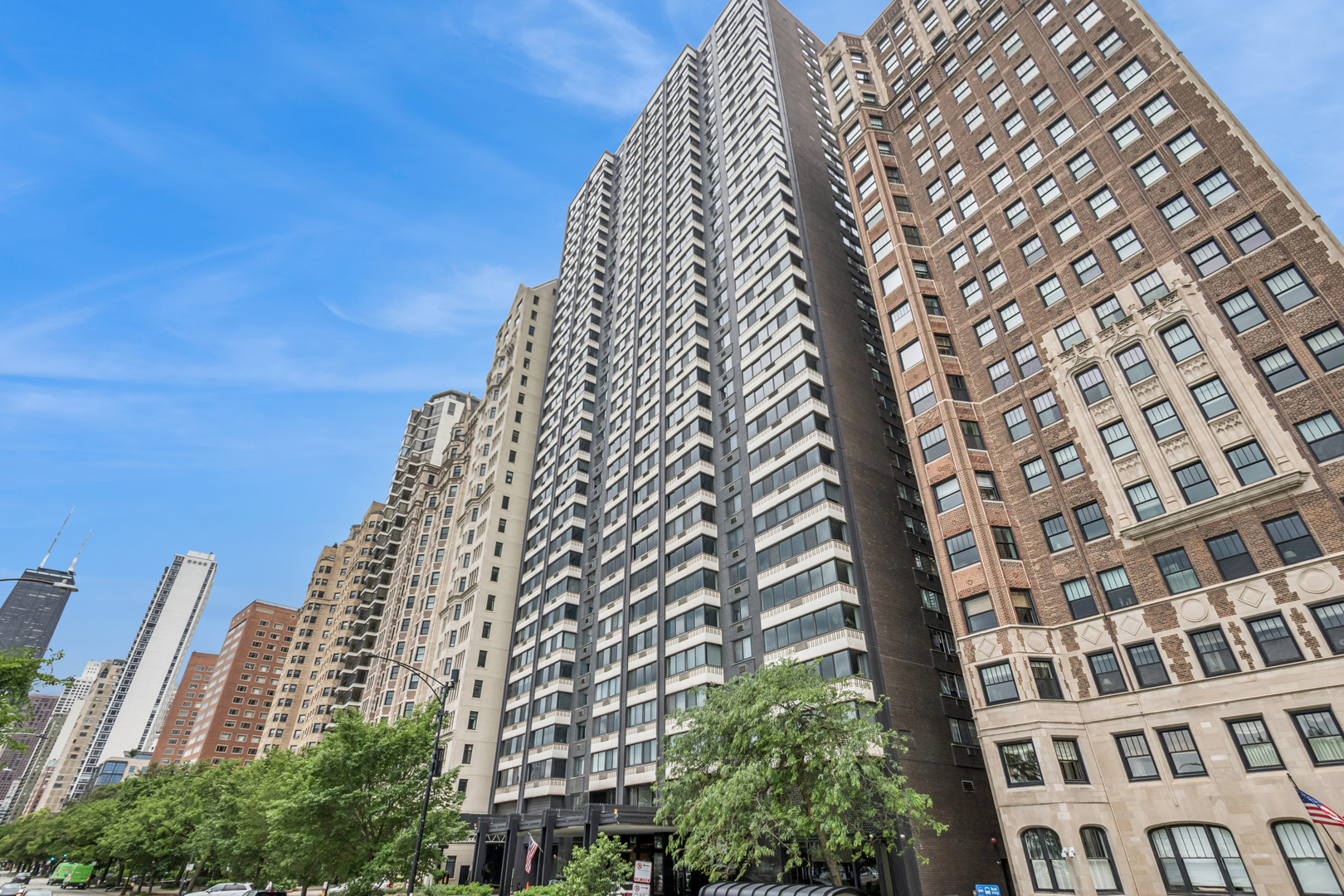
Picture two concrete high-rises from the early 1970s, a few blocks apart on the lakefront. From the lobby they look identical. But one replaced its plumbing risers three years ago and has been quietly saving for the façade work since. The other has been talking about both projects for two years and hasn't voted on either.
I've been selling downtown Chicago condos since 1987, and the question I hear most from buyers is some version of "is this building going to hit me with a special assessment?" Here's what I tell them: in a condo you aren't just buying your unit. You're buying a share of the roof, the elevators, the plumbing, the balconies and the boiler. Every one of those has a lifespan, and every building eventually replaces its roof. That's not a crisis; that's ownership. The only real question is whether this building plans for it or gets surprised by it — and that is something you can read.
Why you can't just wait for the condo documents
In Illinois, the seller requests a disclosure package from the association — the 22.1 disclosure — after you're under contract, and the board has ten business days to produce it. It's a useful document: reserve balance, last financial statement, pending lawsuits, and capital expenditures the board anticipates in the next two years. Your attorney reviews it, and you have a short window to walk away if what's in it isn't acceptable.
Two things to notice. First, the timing — it arrives after you've negotiated. Second, that word anticipates. A board that has been discussing a façade project but hasn't voted on it can say, in good faith, that nothing is anticipated. The document is honest. It's just a rearview mirror.
None of that is a reason to worry. It's a reason to start earlier. I treat the 22.1 as the confirmation step. The discovery happens before the offer, with five questions.
Question 1: What has the building actually done?
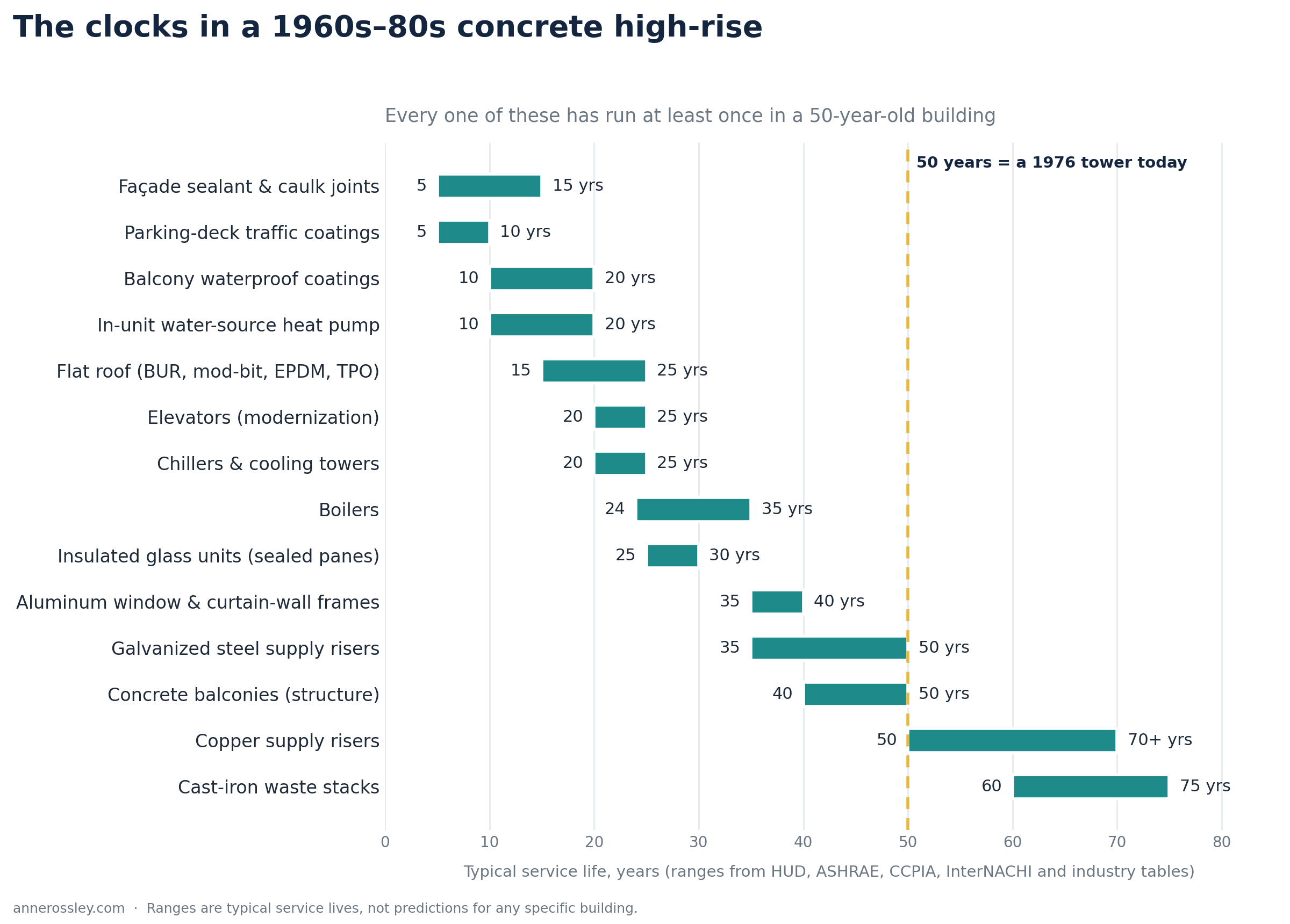
A concrete tower from the 1960s or '70s is fifty-plus years old, and every major system in it has a natural lifespan. In a building that age, every one of those clocks has run at least once. So there are really two kinds of fifty-year-old towers: the ones that have already done the work, and the ones that have it ahead of them. Both can be good places to live — but you want to know which one you're buying into, and the first kind leaves a paper trail.
The City of Chicago publishes every building permit issued since 2006, searchable by address, for free. A well-run older tower shows its history: façade restoration, elevator modernization, riser replacement, a new roof. The same site lists building violations. One old violation is noise; a pattern of open ones is worth a question.
Where to look
- Chicago Department of Buildings address search — permits, inspections and violations on one page: http://webapps1.chicago.gov/buildingrecords
- Chicago Data Portal — Building Permits (2006–present): data.cityofchicago.org
- Chicago Data Portal — Building Violations: data.cityofchicago.org
This takes about ten minutes. Almost nobody does it.
Question 2: Does the building have its façade report?
This one is a Chicago gift to buyers. Any building 80 feet or taller — roughly eight stories — must have its exterior walls, explicitly including balconies, examined by a licensed architect or structural engineer on a recurring cycle, with the report filed with the City. The owner is required to complete the repairs the report calls for.
Façade and balcony work is one of the largest bills a concrete tower ever faces, and the City has already made the building get a professional opinion on it. The report exists. Ask the listing agent or management to see it. If it's current and the repairs were done, you're looking at a building that manages its biggest risk. If nobody can find it, you've learned something without spending a dollar.
Question 3: How does money get into the reserves?
Not "how much is in reserves" — how does money get in? There are two ways:
- A dedicated reserve line in the budget. A fixed contribution every month, in good years and bad.
- Whatever's left over. Reserves get funded only after operating bills are paid — so the year insurance jumps (and Chicago association insurance has been jumping), nothing goes in.
Illinois law requires the budget to "provide for reasonable reserves" and tells the board what to consider: the useful life of what it maintains, replacement cost, and any professional reserve study. A dedicated line is evidence somebody did that math.
Your lender will care too. Fannie Mae currently wants at least 10 percent of a condo budget going to reserves for a loan to qualify under full review, and that floor rises to 15 percent for applications dated January 4, 2027 or later. That's the minimum; reserve professionals generally recommend more for buildings with elevators and heavy mechanical systems. A 1970s tower with four elevators putting 6 percent into reserves isn't a reason to walk — it's a reason to ask the next question.
Question 4: Is there a reserve study, and how funded are they?
"They've got a year's worth of assessments in the bank" tells you almost nothing. A building with $2 million in reserves and a $4 million riser project ahead is in worse shape than one with $500,000 and new risers. It's like judging whether a family has saved enough for college without asking whether the kid is four or seventeen."They've got a year's worth of assessments in the bank" tells you almost nothing. A building with $2 million in reserves and a $4 million riser project ahead is in worse shape than one with $500,000 and new risers. It's like judging whether a family has saved enough for college without asking whether the kid is four or seventeen.
Reserve professionals use a measure called percent funded: the money the building has, divided by what a reserve study says it should have today given the age and replacement cost of everything it owns. Under 30 percent funded is considered weak, with a high risk of special assessments. Seventy percent and up is strong.
What Illinois actually requires
Here's something that surprises people: Illinois does not require a condo building to have a reserve study. The law requires "reasonable reserves" and lists a study as something the board may obtain. A bill that would have required one every five years stalled in committee in Springfield this spring, and no state agency audits condo boards. In practice, nobody is checking a building's reserves except the owners, the lenders — and you.
So the way I'd put it: Illinois doesn't require a reserve study. It requires reasonable reserves, and a reserve study is how a well-run board proves its reserves are reasonable. The national standard calls for a site-visit update at least every three years, and Fannie Mae's project questionnaire asks whether there's one from the last three years. If a building has one, it's kept with the association's records — so it's there to be asked for.
If there's a current study, most of your work is done. If there isn't, that's common and not a dead end. You lean harder on the permit history and the façade report, and your attorney asks the board directly how they set the reserve number.
Question 5: Who is running the building?
There's no database for "does this board know what it's doing," but there is a checklist, and everything on it is verifiable:
- A licensed manager. Illinois requires community association managers to be licensed; the state has a public lookup.
- Credentials beyond the license. CMCA, AMS, and PCAM — the top designation takes five years of experience.
- A credentialed reserve analyst. Look for a Reserve Specialist (RS) or Professional Reserve Analyst (PRA); both organizations publish directories.
- Minutes. Illinois requires boards to keep seven years of them. A motivated seller can usually get you the last year or two. Read them for four words: engineer, study, proposal, special.
- The people who know. Talk to the doorman and the building engineer. "What's the big project everyone's talking about?" is a fair question at a showing.
Putting it together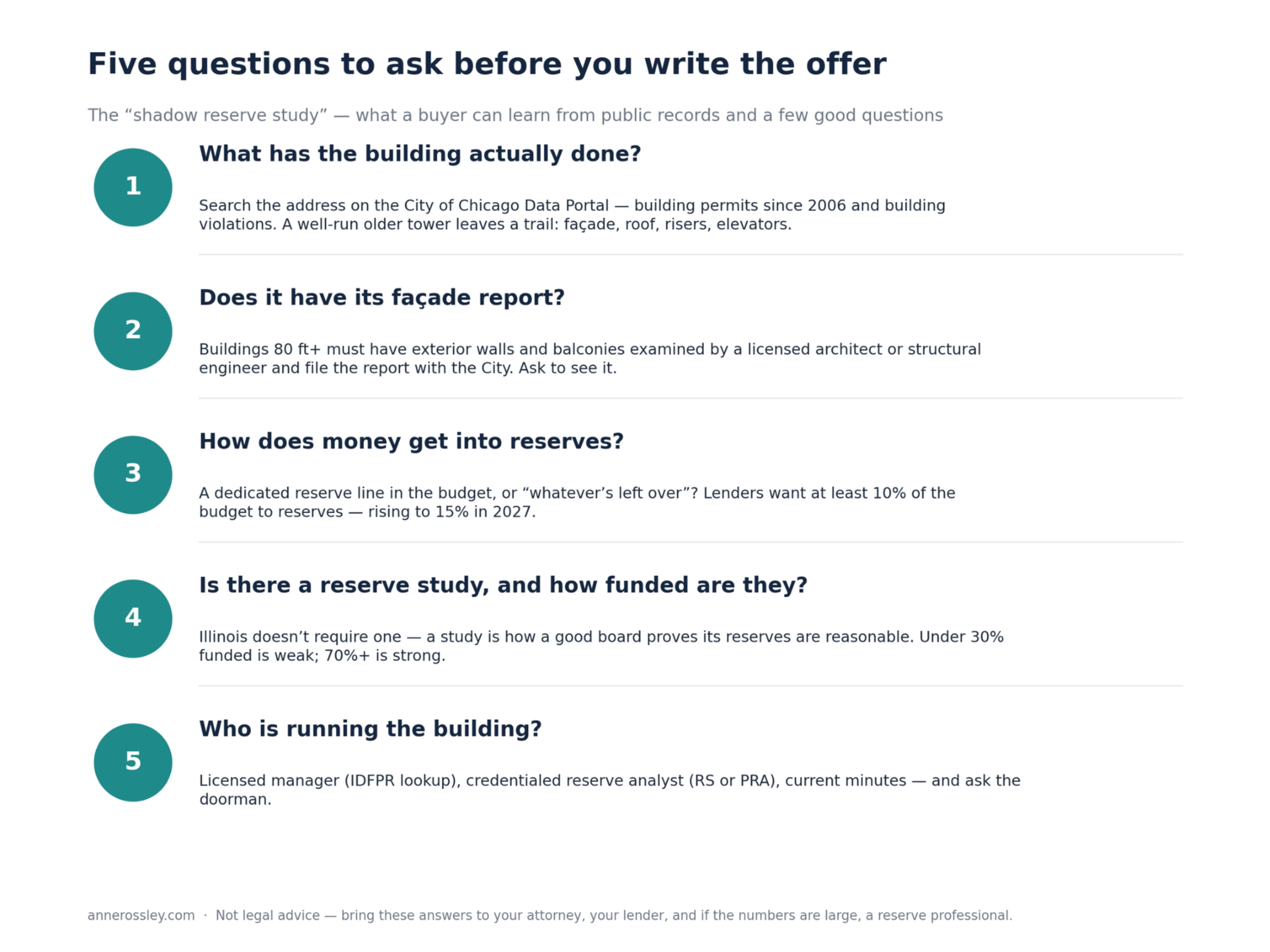
Do the five, then go under contract. When the real 22.1 arrives, you're not discovering — you're comparing. If the permits show a riser project, the façade report is current, there's a healthy reserve line, and the 22.1 says nothing is anticipated, that's a consistent picture. If the permits show nothing, reserves come from leftovers, there's no study, and the 22.1 also says nothing is anticipated — that's an inconsistent picture. It doesn't mean you walk. It means you know exactly what to ask, and you can price it in, negotiate it, or decide with your eyes open.
I'm a broker, not a lawyer. Your attorney reads the documents and tells you what they mean for you. Your lender tells you whether the building qualifies. If the numbers are large, reserve professionals and engineers do nothing but this. Your job is to walk into those conversations with the questions already answered.
Remember the two towers? Both are still good places to live. The difference is that in one of them, the owners saw it coming.
Frequently asked questions
Does Illinois require condo associations to have a reserve study?
No. The Illinois Condominium Property Act requires budgets to provide for "reasonable reserves" and lists a professional reserve study as something a board may obtain. A 2026 bill that would have required a study every five years stalled in committee.
When do buyers receive the 22.1 disclosure in Illinois?
After you're under contract. The seller requests it from the association, and the board has ten business days to provide it. Your attorney reviews it during your contingency period.
What is "percent funded" for condo reserves?
The reserve balance divided by what a reserve study says the building should have on hand today, given the age and replacement cost of its components. Under 30 percent is generally considered weak; 70 percent and above is strong.
____________________________________________________________________________________
Looking at a downtown condo and want a second set of eyes on the building's budget? Contact me at /buying/, or explore current listings and home values in Gold Coast, Streeterville, River North and Lincoln Park.
About Anne Rossley — Managing Broker at Baird & Warner Gold Coast and a downtown Chicago condo specialist since 1987, with a focus on historic buildings, downsizers and luxury properties. More about Anne.