Chicago walk-up condos priced between $500,000 and $800,000 are competitive, especially when they offer good space, outdoor living, parking, and a manageable monthly assessment. Recent closed sales show that buyers need to move quickly, understand the differences between Lakeview, Uptown, and Edgewater, and budget carefully for both the unit and the building.
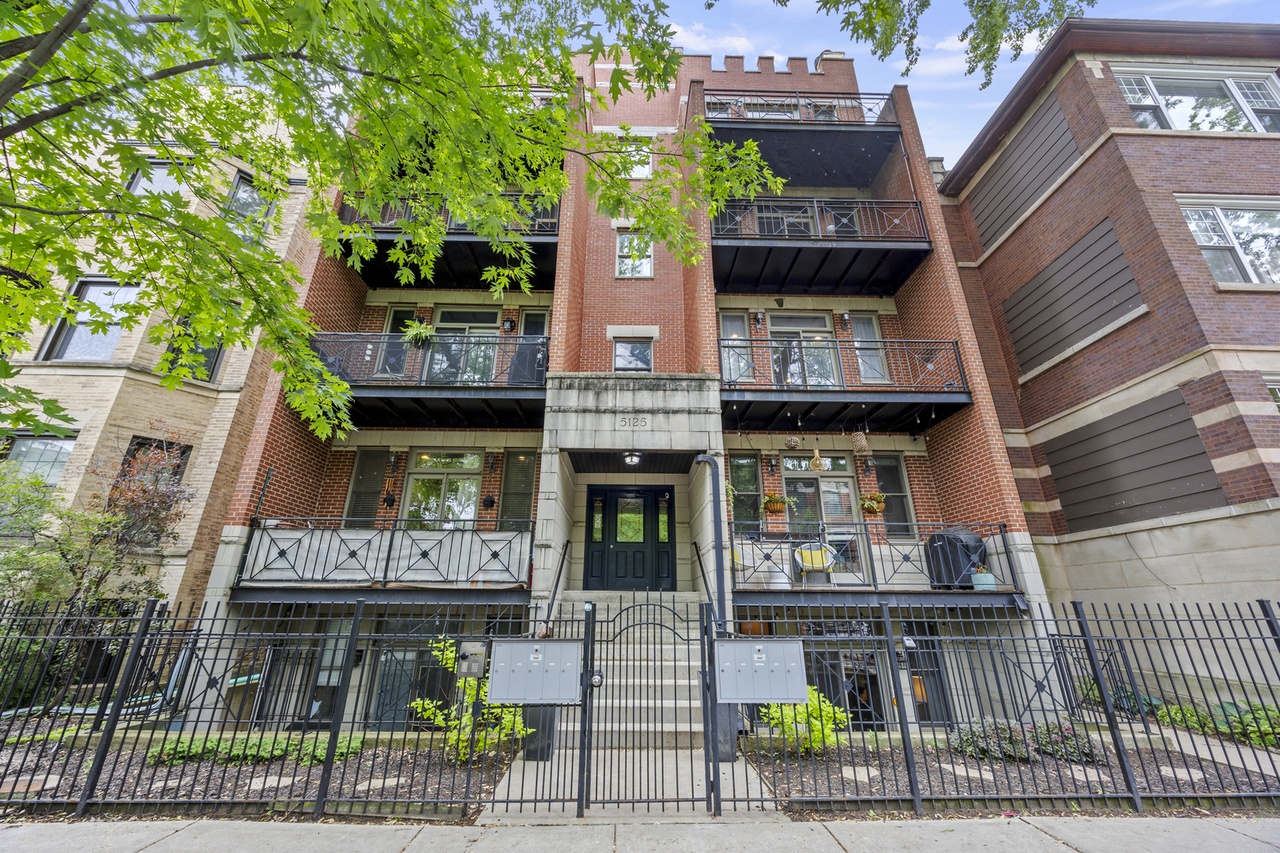
I reviewed every 2- and 3-bedroom condo in a small, mostly walk-up building that closed in Lakeview, Uptown, and Edgewater between $500,000 and $800,000 during the six months ending September 11, 2026. The analysis included 278 closed sales, along with 64 listings that were canceled or expired without selling.
Five Things to Know Before Buying a Chicago Walk-Up Condo
1. You will be competing
Two out of three condos in this group went under contract within one week of listing, and approximately eight out of ten sold at or above the asking price.
The typical sale closed about 7% above the original list price, while four out of ten sales closed more than 10% over list.
This means preparation matters. Before your first showing, you should have lender pre-approval, proof of funds, and a clear understanding of your inspection and attorney-review preferences.
2. Your real budget ceiling is about $730,000
If your total purchase budget is $800,000, shopping at the full $800,000 asking price may leave little room for competition.
On a well-priced property, buyers should be prepared for a closing price 5% to 10% above the original asking price. A $799,000 listing is not necessarily an $800,000 purchase in this market.
3. Lakeview costs more per square foot, while Uptown generally offers more space
The same budget buys approximately 15% to 20% more square footage in Uptown than in Lakeview, with Edgewater generally falling between the two.
Lakeview offers strong walkability and access to a large number of neighborhood amenities. Uptown and Edgewater can provide more space for the money, particularly for buyers prioritizing a third bedroom.
4. Outdoor space and parking are common features, but quality varies
More than nine out of ten sales included some form of private outdoor space and parking.
However, there is a significant difference between a garage space and an outdoor pad, or between a large private deck and a small balcony. Buyers should look closely at the actual usability of these amenities rather than simply checking whether they are included.
5. Pet rules are often the blind spot
Fewer than one in four listings clearly stated their pet policy.
In a small six-unit building, the rules may be found in the condominium declaration or association documents rather than the listing description. Before you fall in love with a property, we verify the pet policy in writing.
What Your Budget Buys, Neighborhood by Neighborhood
The table below is built only on closed sales: what buyers actually paid, not what sellers asked. "Typical" means the median: half the sales were above it, half below.
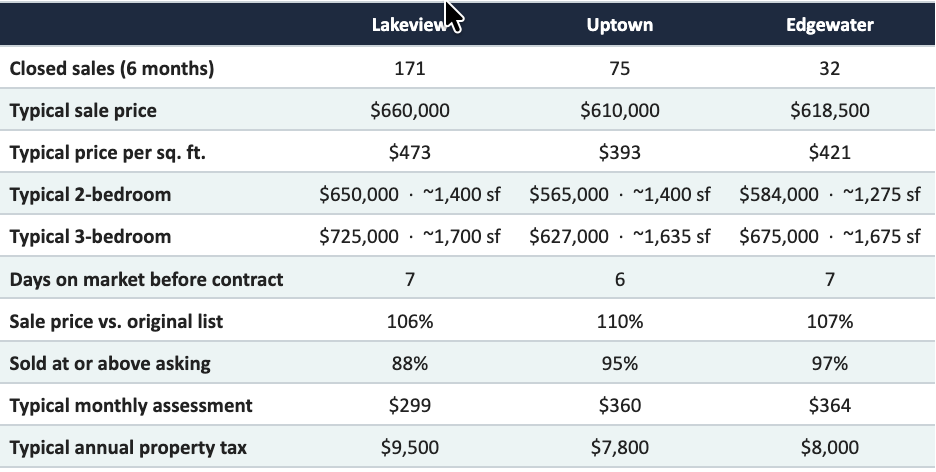
Two things stand out.
First, Uptown was the most competitive of the three neighborhoods on price. Sales there closed at the widest margin above asking, and very few sold below list.
Second, the neighborhoods become more different near the top of the price range. Between $500,000 and $550,000, all three neighborhoods generally offer a 2-bedroom condo of approximately 1,350 square feet, often in a vintage building.
Above $750,000, Lakeview becomes more prominent. Twenty-three of the 32 sales in that price range were in Lakeview, and 22 of those 32 sales were 3-bedroom condos of approximately 1,570 square feet. Four out of five included garage parking.
Vintage vs. Newer Construction
Approximately four out of ten sales were in buildings at least 90 years old, including classic Chicago greystones, brick three-flats, and courtyard buildings.
Vintage units sold for a typical $605,000, or $394 per square foot. Buildings from the 1990s onward sold for a typical $668,500, or $462 per square foot.
That difference often reflects features such as attached garage parking, in-unit laundry designed into the floor plan, and newer building systems. In older buildings, buyers also need to consider future expenses involving porches, roofs, windows, tuckpointing, and other shared maintenance.
Only eight of the 278 sales were new or nearly new construction. Those units sold for approximately $760,000, making new construction the exception rather than the typical option at this budget.
Timing: How Fast You Will Have to Move
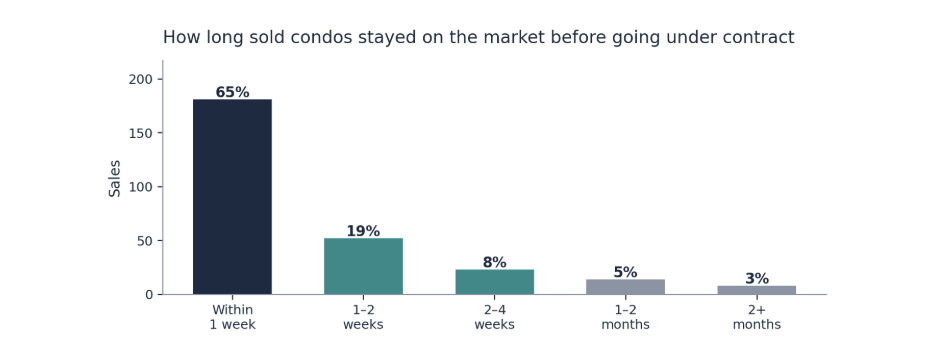
Timing is one of the most important factors in this market.
Sixty-five percent of the condos that sold went under contract within one week. After two weeks, that figure reached 84%.
In practice, the pattern can be familiar: a listing comes on the market Thursday, showings take place over the weekend, offers are due Monday or Tuesday, and the property is under contract shortly afterward.
If a property reaches its second weekend without an offer, there may be a pricing issue or something in the listing that is discouraging buyers. Both situations can affect how we structure an offer.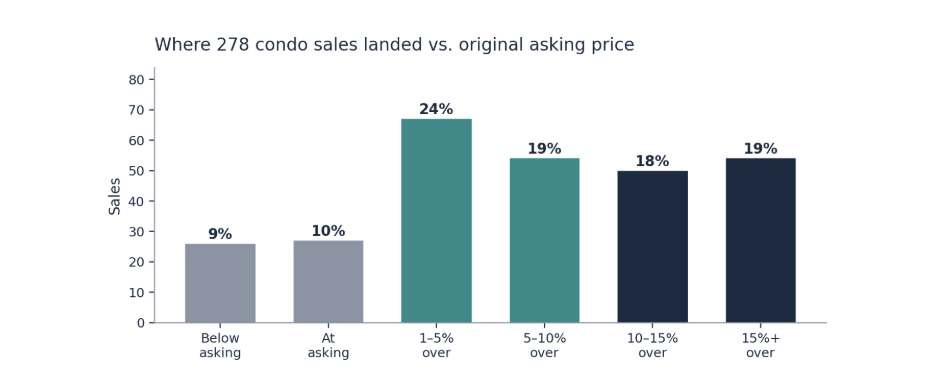
The homes that sold quickly were also the ones that sold for more. Properties that went under contract within one week closed at a typical 110% of asking, while those that remained on the market for more than two weeks closed at asking on average.
The 64 canceled or expired listings tell the other side of the story. These properties were priced approximately 8% higher per square foot than the condos that sold and were withdrawn after a median of 24 days.
Overpricing is being punished. A property that has been relisted or reduced after three or four weeks may offer more negotiating opportunity than a brand-new listing.
What This Means for the Offer
On a well-priced, well-presented home you should expect to offer above asking, keep contingencies tight, and have your lender pre-approval and proof of funds ready before the first showing.
On a home that has sat for three weeks or more, the leverage shifts to you, and the conversation becomes about inspection findings and building finances rather than price escalation.
Knowing which situation you are in before we write is most of the job.
Amenities: What Comes Standard, and What You Pay Extra For
The figures below come from reading the listing descriptions of all 278 sales. They understate reality a little. An agent who forgets to mention the washer/dryer does not make it disappear, so read them as "at least this common."
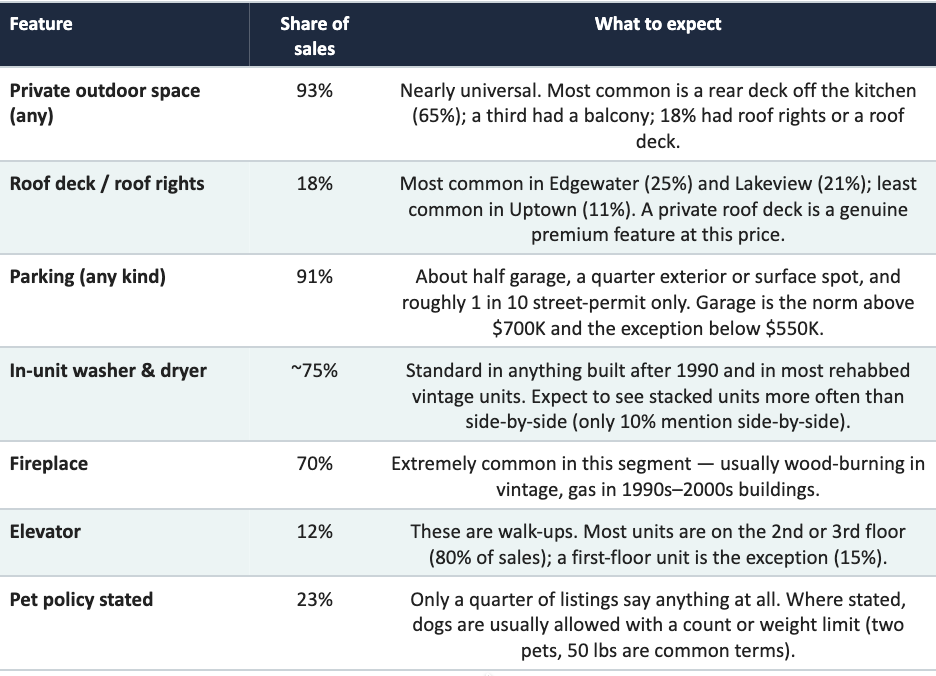
Balcony Versus Deck Versus Roof
In these buildings, "outdoor space" means three very different things.
A vintage 3-flat gives you a rear wood porch or deck, often shared stairs, sometimes with a private landing, and in the best cases a private roof deck reached by an interior stair.
A 1990s or 2000s masonry building gives you a real balcony off the living room and a common roof deck.
A rehabbed greystone may give you a front terrace and a rear deck.
The difference matters for how you actually use it: a north-facing 5-by-8 balcony over the alley is not the same amenity as a 400-square-foot south-facing roof deck, and the market prices them accordingly.
Parking
Nearly every sale had something, but "something" ranges from a heated attached garage to an assigned outdoor pad behind the building.
In Lakeview, sales with parking mentioned went for a typical $669,500 against $570,000 without it, but that gap is partly the parking and partly that the no-parking units are older and smaller.
Where sellers put a number on it, an extra exterior space was offered at $25,000, and rented spaces nearby ran $150 to $325 a month, so a garage space that comes with the unit is worth real money.
Ask whether the space is deeded, which was rare here, a limited common element assigned to the unit, or rented from the association, because each is treated differently at resale.
Dogs and Cats
This is the item I want you to be most careful about.
Three out of four listings never mention pets. In a 6-unit self-managed building, the rule is written in the declaration and enforced by whoever is on the board that year.
Common terms in the listings that did disclose included two pets maximum, a 50-pound weight limit, or "one dog or two cats."
Before you write on any building, we get the declaration and rules in hand and confirm the policy in writing. The 22.1 disclosure package will not always spell it out.
Monthly Costs
Assessments in small buildings are low relative to a doorman high-rise, typically $300 to $365 a month, but low is not the same as adequate.
Most of these buildings have no professional management, a reserve account that may or may not exist, and a roof, porches and tuckpointing that will eventually be paid for by whoever owns the units that year.
Property taxes run about $9,500 a year in Lakeview, $8,000 in Edgewater and $7,800 in Uptown for these units, and are the larger of the two carrying costs.

An assessment below $200 in a vintage building may be a reason to ask more questions, not simply a reason to celebrate a bargain. When reviewing a building, I want to know:
- How much money is in reserves?
- When were the roof, porches, and boiler last replaced or repaired?
- Are major projects being discussed?
- Is there a current or proposed special assessment?
- What do the last two years of budgets and association minutes show?
The assessment is only one part of the monthly cost. Property taxes can be a larger carrying expense in this price range.
How I Would Approach the Search
- Shop asking prices up to about $730,000, not $800,000. That leaves room to win a competitive property and still close within budget.
- Lead with Uptown and Edgewater if space and a 3rd bedroom matter most; lead with Lakeview if resale strength and walkability to the largest number of amenities matter most. Lakeview has the deepest market, with 171 sales, and the highest per-foot value.
- Be ready to act inside 72 hours with pre-approval, proof of funds, and a decision on inspection and attorney-review timing already made.
- Watch the relists. Nearly one in five listings in this segment failed to sell. When they come back reduced, that is where a full-price, contingency-intact offer wins.
- Verify pets, parking type and laundry in writing before the offer, not during attorney review.
- Budget for the building, not just the unit. Ask for the last two years of budgets and minutes on any small building you are serious about. I will walk you through how to read them.
The Bottom Line
A $500,000–$800,000 budget can still buy a well-located 2- or 3-bedroom condo in Lakeview, Uptown, or Edgewater, but the buying experience depends on more than the asking price.
Lakeview generally commands a higher price per square foot. Uptown can offer more space and showed strong competition in this data set. Edgewater sits between the two in many respects and can offer a balance of space, amenities, and price.
The most important questions are not simply, “How much can I afford?” They are:
- How much space do I need?
- Which neighborhood fits my lifestyle?
- How quickly can I make a decision?
- What will the monthly assessment and property taxes cost?
- Is the building financially healthy?
- Are the parking, pet, and outdoor-space details clearly documented?
That is where careful preparation makes the difference.
About This Data
Source: Midwest Real Estate Data (MRED) MLS, condominium listings in MLS areas 8006 (Lake View), 8003 (Uptown) and 8077 (Edgewater), 2–3 bedrooms, original list price $500,000–$800,000, buildings of 3–24 units, with closed dates March 13–September 11, 2026.
The analysis includes 278 closed condo sales, with townhouse and duplex-townhome records excluded, plus 64 cancelled or expired listings and 6 pending listings analyzed separately.
Amenity percentages are derived from listing descriptions and represent minimums. Figures are medians unless noted.
Sales that closed above $800,000 from listings under $800,000 fall outside this data set, which means the over-asking figures near the top of your range are, if anything, understated.
This report is informational and not an appraisal.